
Incredible journeys of our tiny tara iti
DOC’s tara iti recovery programme reached a huge milestone this summer, helping grow the population to nearly 50 birds. Additionally, there were 11 fledglings this season, five of which were raised through the highly promising captive rearing programme.
But the work doesn’t stop there. Understanding how tara iti fare after leaving the captive rearing aviary is a crucial next step for protecting New Zealand’s most endangered bird.
Put simply – if we don’t know where they are, we can’t protect them.
Historically, locating tara iti has relied on people searching with binoculars. But with adults measuring just 25cm and weighing only 70g, finding these tiny birds is akin to looking for a needle in a haystack.
Thankfully, new technology co-funded by the Shorebirds Trust and DOC is helping reveal remarkable insights into the movements of tara iti outside of the breeding season.
Since the 2023/24 season, captive-reared chicks have been fitted with fairy-sized satellite or GPS trackers. Weighing just three grams, the solar-powered trackers are attached via a silicone harness, just like a tiny backpack.
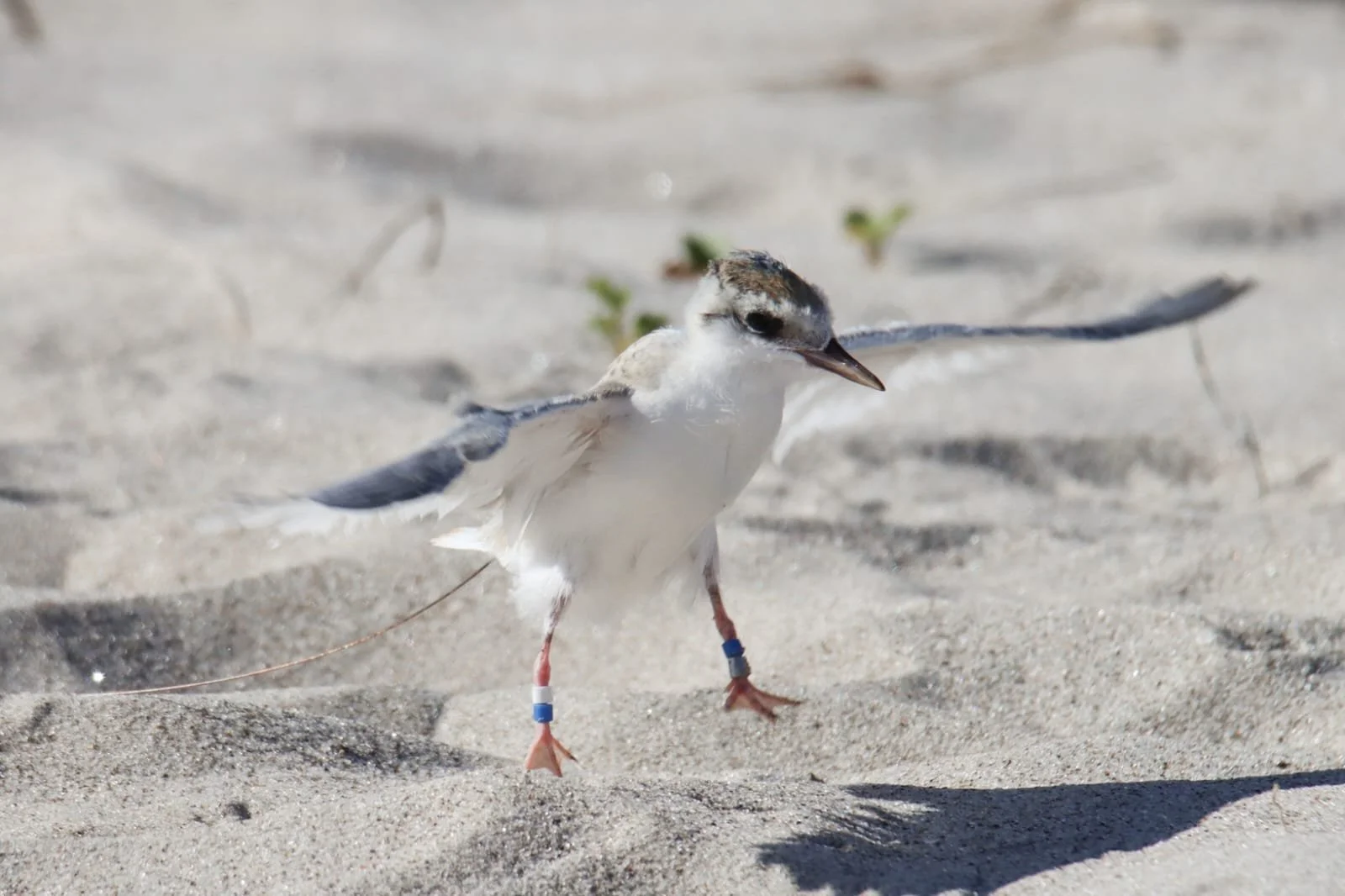
Tara iti chick testing out its new tracker. Photo: Department of Conservation.
The trackers have revealed important insights, including confirming local movements, the use of previously unknown sites, incredible long-distance adventures, and a surprising amount of nighttime activity.
Decades of observational work have established Kaipara Harbour as the principal non-breeding area for tara iti and, unsurprisingly, tracking data confirmed repeated use of the historically important roosting sites by captive-reared juveniles. This supports the need for ongoing conservation management at these key sites, including predator control, disturbance management and habitat maintenance.
Tracking data also revealed juveniles using areas rarely documented or previously unknown. Some of these were within the Kaipara Harbour system, while others were much further afield.
Repeated use of far-north harbours such as the Hokianga and Rangaunu suggests that these currently unmonitored sites may provide important refuges and alternative feeding areas during poor weather. Incorporating these new sites into seasonal surveys may help improve the detection of juvenile birds.
Long-distance journeys, often at night, included trips as far north as Cape Reinga at the northernmost tip of New Zealand. Visits south included Manukau Harbour, Coromandel, west coast harbours like Whaingaroa (Raglan) and Kawhia. One bird even travelled as far south as New Plymouth – an estimated 632km return trip.
Tracking map of a juvenile tara iti. Video: Department of Conservation.
These extensive movements demonstrate juveniles are capable of long-distance dispersal, presenting both exciting opportunities and new challenges, including the need to expand management beyond existing key areas.
Often thought of as a bird of the Kaipara, this tracking research is reinforcing the idea that tara iti are truly a bird of New Zealand.
Another Shorebirds Trust and DOC co-funded research project currently underway is investigating the historical distribution of tara iti and using advanced eco-modelling to identify potential future breeding sites.
The combined impact of these research projects will be crucial in guiding management decisions to support an expanding tara iti population. It really is an incredibly exciting time for tara iti conservation.